
How Do You Know What A Preaching Portion Means?

Adding a Meaning Element from Speech Act Theory

Yesterday I had the privilege of joining Dr. Mark Meyer, Hebrew specialist at LBC|Capital, at their D.C. location (Greenbelt, MD) for a workshop, Unpacking Sacred Scripture. We worked together in Psalms 1 and 2, the introduction to the Psalter, to show the combined exegetical and homiletical process. Our goal was to help close the gap between finding meaning and application.

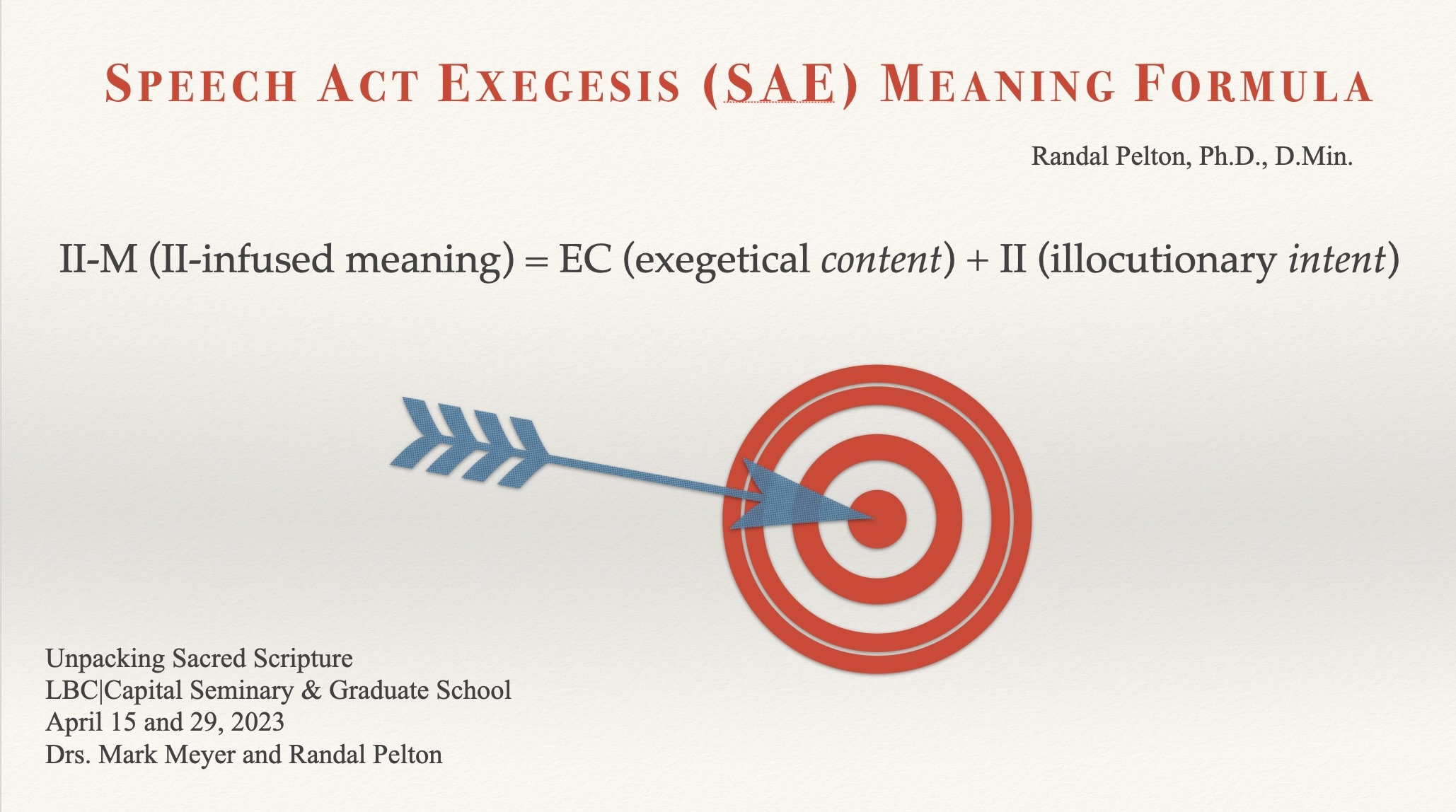
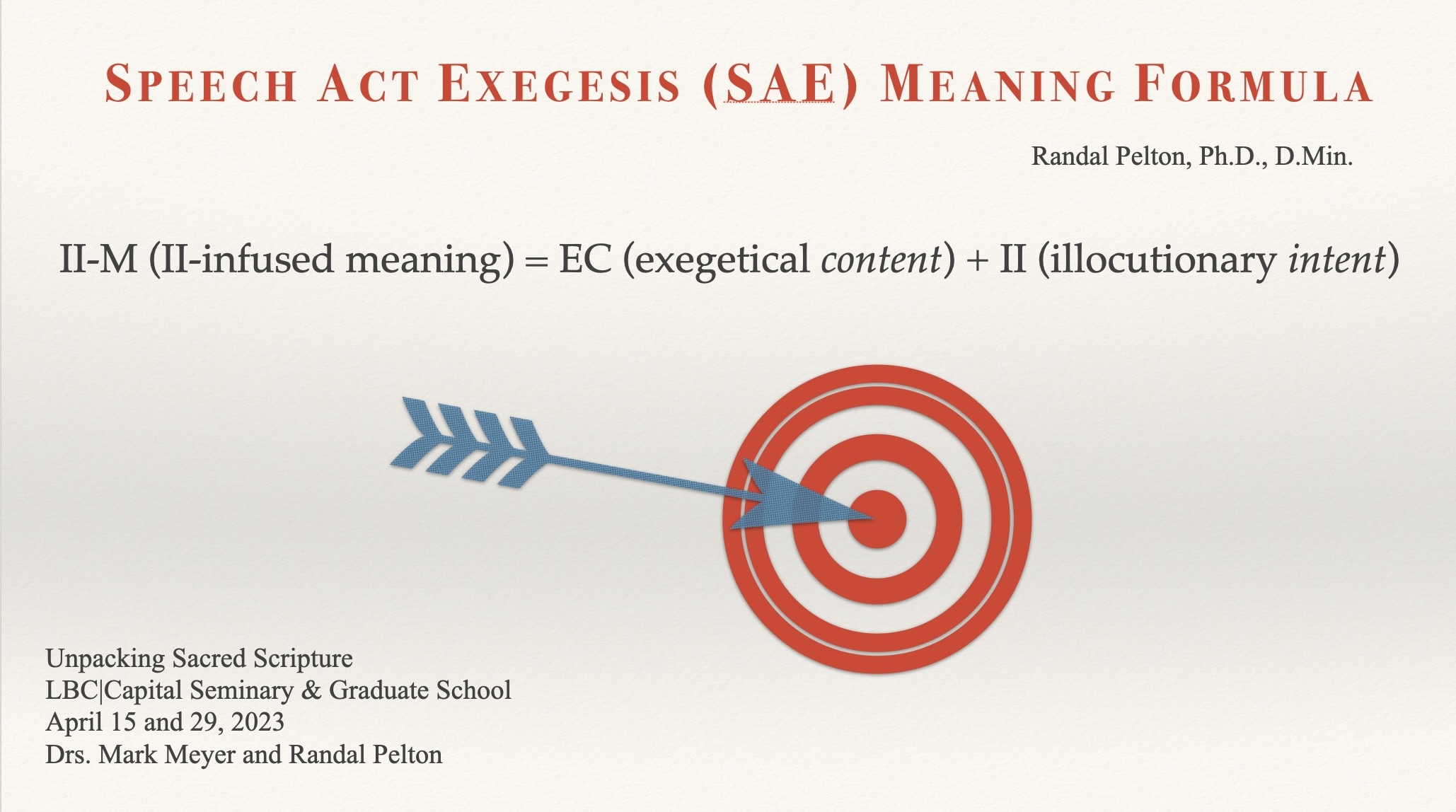
One of my responsibilities was to introduce the participants to a new kind of meaning summary. You can see that in this slide:
Consider this kind of meaning to be your goal as you begin sermon or lesson preparation this week.

I call our target meaning, illocutionary intent-infused meaning (II-M). I’ll spare you the boring details and only say that this fancy language originates from Speech Act Theory and their concept of illocution. Illocution describes what a person is doing by what they are saying.

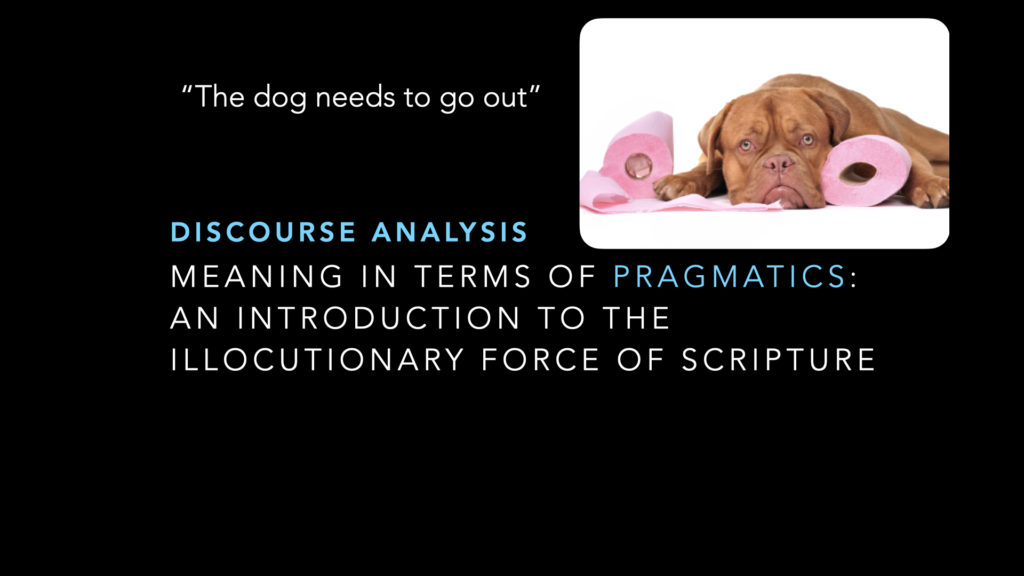
My favorite illustration of the illocutionary element of communication is my wife, Michele, saying, “Ran, the dog needs to go out.” If I respond with, “That’s nice, Dear,” and go back to my very important job of writing a blog post, then I missed what she meant. In saying, “The dog needs to go out,” she’s really asking me to take the dog out. That’s what she was doing in what she was saying.

As you can see from the slide, II-M is the combination of biblical content and biblical intent. The intent part is critical because this contains the seeds of valid application derived from the meaning of the text.

So, before Sunday, see if you can detect your pericope’s intent. Answer this question from your text:

What does God intend for this Scripture to do to the listener?

If you can add intention to your meaning summaries, you will always keep primary application tied directly to meaning. And, I am suggesting that we really do not know what a Scripture means until we have identified how God intends for it to function for the church.

So, as you begin to identify the meaning of your upcoming Text, complete the meaning summary by adding: “____________ with the intent of_________”

May our Lord receive glory in the church and in Christ Jesus (Ephesians 3:21) as we communicate both content and intent.

Randal

Me and God in the Study

Thinking about what I actually bring to the equation for a given Sunday Sermon

This weekend I am thinking about what I actually bring to the equation with respect to sermon development. I had the privilege to preach Luke 14:25-35 this morning where Jesus explains the high cost of following Him.

Sometimes I feel that I contribute very little except for the ability to read the best material that other scholars have provided. It is an important part of preaching, but I thought we might give this some thought.

First, is this feeling true? To what degree do I add original material to my sermons? Second, if it were true, is that okay?

So, first, it is not true. Each week I select my preaching portion, trace the argument of that Scripture, and begin my analysis without consulting any of the best exegetes and theologians I can access. Being able to read Hebrew and Greek help me use excellent lexicons to get to critical definitions-in-context. Oh, and God’s Spirit operates in answer to my prayers for insight: “Lord, grant to me keenness of mind, capacity to remember, skill in learning, subtlety to interpret…”

But, more than that, each Monday provides an opportunity to also identify the big idea and intention of that passage. I now know what God intends to do to those in our faith-family that have ears to hear. And I know enough of the flock to know this is going to be a very important act of watching over souls.

Second, if it were true that I brought very little to the sermon equation, it would not be okay. God has called me and is equipping me to help shepherd a little flock. Not someone else. So, while I might benefit from Marshall’s fine treatment of Luke 14, it can’t be Marshall’s sermon.

As we head back to work tomorrow morning and begin preparing for our next sermon, let’s enjoy our time with God and His Word so He receives glory in the church and in Christ Jesus (Ephesians 3:21).

Randal

The Critical Move from Meaning to Application

Okay, maybe not “Good Results,” but, certainly, “Good Intentions.”

Not good results because we can’t guarantee “ears to hear.” We can’t guarantee that our listeners will respond to God. But we can guarantee that each Sunday we will supply God’s intention for the preaching portion.

Tomorrow, as you begin working on your Sunday sermon, be prepared to complete the following sentence:

“This morning, we worship our Lord by _______________________________.”

You and I fill in the blank with God’s intention for the passage of Scripture. This is the foundation for all expressions of application.

So, as you begin to practice your exegetical method this week, include the search for the intention of the passage. You will have to look for clues provided by the biblical author. It’s easiest usually in the epistles; toughest usually in OT narratives.

The main thing is to ask yourself what God intends to do in what He has written. Or, you might ask it this way: “How does God intend for this Scripture to function for the church?”

If done correctly, the way you fill in the blank above will be determined by the big idea of your preaching portion. The meaning and application are organically related through God’s intention.

So, while you can’t guarantee good results (actual worship), you can guarantee you will communicate good intentions, God’s intentions for the passage.

And He will receive glory in the church and in Christ Jesus (Ephesians 3:21).

Randal

P.S. I practice trying to complete the worship response as early as possible in my work week. That way, I do not have to wonder how the exegesis is functioning all week long. I am thinking about application early on in the process. And since God’s intention is the focus, I don’t have to worry about the search for application tainting the exegetical process (kind of an ole school approach!).

Thinking of Application in Terms of Intentionality

The Text Signals It’s Intention By It’s Shape

Even if you were not familiar with the three tools shown above, you could probably figure out what they were intended to do. Just look at their shape. Also, think about what would happen if you tried to make their functionality interchangeable. Imagine using the saw in the middle for a hammer!

Biblical texts–our preaching portions–signal their intention by their shape. Theology is conveyed through literary structure, things like grammar and syntax, and the type of literature. That’s why I live and die by this method:

After I pray Aquinas’s famous prayer, “Grant to me keenness of mind…”, my first study minutes are devoted to tracing the argument of the passage.

Pauline epistles convey their theology through logical argumentation. Old and New Testament narratives communicate through their storyline. Old Testament poetry preaches through parallelism.

That’s all simplistic, I know, but true enough to make the point.

Our search for applications begins with a search for intentionality. Here’s the key question:

What does God intend to do to His readers in this preaching portion?

Answer that and you’ve got the foundation for any form of application from that pericope.

In order to answer that question, you have to know what to look for. The epistles or other didactic genres (types of literature) are easiest, I think. Follow the imperatives and the logical flow. Doctrinal sections intend for readers to affirm them as real, real enough to elicit praise and corresponding lifestyle.

Narratives are the worst. We can talk about that next time, Lord willing.

For now, as you head into another work week, be thinking in your first hours of study what God intends to do to His readers, your congregants so He receives glory in the church and in Christ Jesus (Ephesians 3:21).

Randal

Could You Still Preach Your Sermon If…?

Would it matter to your sermon if no one was listening?

One of my mentors, the late, Dr. Haddon Robinson, taught me about the difference between preaching and lecturing. He put it this way:

“We don’t talk to our listeners about the Bible; we talk to them about them from the Bible.”

My wife, Michele, recently had an opportunity to listen to another preacher from a local church. I don’t blame her. To quote my mentor again, she’s heard enough poor sermons in her lifetime–bless her heart–it’s no wonder she’s still a Christian. [I’ve preached over 2,000 sermons and she’s heard most of them!]

So, I asked her the question that ranks second in my order of importance:

“Was the preacher talking to you about the Bible or talking to you about you from the Bible?”

Without hesitation she replied: “The first one.”

The first scenario, the lecturer’s stance, does not require listeners. Take a look at last week’s sermon or what you have developed so far this week and ask yourself whether or not the way it sounds requires listeners.

Michele followed that up with this insight:

“But if you believe your assignment is to teach the people [insert a book of the Bible or theological concept], then it makes sense to preach like that.”

But if our responsibility is to watch over souls (Hebrews 13:17), then we approach the sermon differently. We talk to them about them from the Bible because we are shepherding them in the moment, urging them to worship our Lord during the teaching.

As you continue to prepare for this weekend’s assignment, as yourself whether you are taking the lecturer’s stance or the preacher’s.

While I am convinced our Lord can receive glory in the church and in Christ Jesus (Ephesians 3:21) either way, I am also convinced you and I are being more responsible soul-watchers to the degree that we continue to talk to them about them from the Bible.

Randal

P.S. By the way, in case you’re interested, the first question of importance is, “Did the preacher preach with accuracy, faithfully saying what God is saying?”

Adding an Angle on Application

If your spouse said this to you, what would they “mean”?

I am in the privileged position to be about 100 pages into my Ph.D. dissertation, writing on a topic that I am extremely interested in:

exploring whether or not an aspect of speech act theory, illocutionary action, provides a welcomed link between meaning and application.

If you’ve been preaching or teaching Scripture for any length of time, you are probably aware of how difficult it is at times–apart from the practical sections of most NT epistles–to move from meaning to application. We were taught detailed methods for doing exegesis; we were not given much help, if any, for doing theological exegesis that highlights Scripture’s function for the church.

Enter pragmatics, speech act theory, and, especially, this thing called illocution.

Using the image above, illocution, analyzes what the person means when they say to someone else, “The dog needs to go out.”

If Michele said that to me and I responded with, “That’s a nice fact, Dear,” she would quickly say, “What I meant was, please take the dog out.”

This morning I had the privilege of preaching Matthew 5:1-12, commonly known as the Beatitudes.

There are two prominent illocutionary acts in these verses. The easiest one to locate is in v. 12. The verse contains the command: “Rejoice and be glad…” The command itself equals the illocutionary intent of Matthew.

The tougher illocutionary act/intent is not so easy, but you will encounter it over and over again in both Testaments. All of vv. 3-11 begin with, “Blessed are…”

Jesus teaches His listeners a statement of reality: these kinds of people are blessed. In order for anyone to put v. 12 into practice, they must first believe that Jesus’s stated reality is true of their situation. The stated reality is intended to elicit an act of faith.

Watch for various statements of reality in either Testament God will receive glory in the church and in Christ Jesus (Ephesians 3:21) as you encourage your listeners to respond in the way God intended.

Randal

Sovereignty And Election Are Extremely Relevant: My Only Post On Preaching Through Romans 1-11

I never thought I would write that the sovereignty of God and His election described in Romans 9-11 are easy to apply to the church! But they are. And I’m getting ahead of myself.

First, when I began preaching through Romans 1-11 a year ago Easter, I determined not to write posts from that series. The reason was simple: I do not consider preaching epistles like Romans to be difficult.

[I realize some of my friends and colleagues just ran to get their EpiPens!]

What I mean is that, although there are difficult theological concepts to explain, the structure and applicability of most epistles most of the time are not too difficult. In the case of Romans 9-11 one of my favorite commentators, Douglas Moo puts it this way:

“…while certain points remain hard to understand, Paul is claiming to be transmitting truth to which his readers are to respond” (p. 740).

Here’s how to locate the intended response for Romans 9-11 and all the heavy discussion of unconditional election:

First, when you begin working through chapter 9 you will need to point congregants forward to 11:17-22. This is Paul’s first indication of how the section functions for the church. There you find instruction for us not to be arrogant toward unbelieving Jews (v. 18), to stand fast through faith (v. 20), not become proud (v. 20), and to live as God-fearers (v. 20). The reason: “for if God did not spare the natural branches, neither will he spare you” (v. 21) and the warning in v. 22, “Otherwise you too will be cut off.”

It is easy to get lost in election in chapter 9 and forget what the section is intended to do to the faith-family.

Two other connections can and should be made. First, the entire section ends with a marvelous doxology in 11:33-36. Everything ends with praise to God. Second, the more practical section that begins in 12:1 stems from all the mercies of God highlighted in 9-11 (“…by the mercies of God”). Unconditional election magnifies the mercy of God which provides motivation for all the instruction in chapters 12-16.

I hope you have had or will have an opportunity to preach through Romans with your faith-family and God will receive glory in the church and in Christ Jesus (Ephesians 3:21).

Randal

Aim The Sermon At Alteration, Not Information

I am enjoying Carrell’s, Preaching That Matters, partly because of all the research she’s done that defines the preaching practices of so many. I didn’t enjoy learning about this:

“…remember that the vast majority of sermons (more than 95 percent) do not invite listeners to change.” (p. 66)

If pastors aren’t inviting their listeners to change, what are they doing? Carrell puts it like this:

“Preacher’s General Purpose: Let me tell you about something.

Listeners’ General Response: I agree with what you said.” (p. 66)

Let’s give ourselves the benefit of the doubt and say we’re telling our listeners about the Bible. And let’s give our listeners the benefit of the doubt and say they often agree with what we’re telling them about the Bible. I agree with Carrell that that’s not enough for what needs to happen on a Sunday morning.

So Carrell talks about not only identifying the subject of your sermon (which you know should come from your preaching portion), but also identifying the response to your sermon. In previous posts I’ve talked about how the intention for the sermon (what the sermon is intending to do to the listener) comes directly from the intention of the preaching portion (what the Scripture is intending to do to the listener).

I am often in the habit of wording it like this: After the public reading of Scripture, I’ll say, “This is God’s Word. We worship this morning by ___________.” I fill in the blank with whatever our Text is intending to do to the listeners. Right from the outset everyone in the house of the Lord knows how the Lord intends to change us.

That means every Sunday, like every New Year, should be an opportunity to make a fresh start.

Before Sunday, along with identifying the subject of your sermon, also identify the worship response so God receives glory in the church and in Christ Jesus (Ephesians 3:21).

Randal

Transformation, Not Just Information: One Challenge for Preaching on Easter Sunday

Blessed Easter!

There are many challenges accompanying the Easter morning sermon. One of the most difficult is keeping the sermon aimed at transformation instead of only information.

It’s an important goal for every sermon, but especially important on a day that emphasizes an event such as the resurrection of Christ.

Transformation is also an important goal because both preacher and parishioner expect “spiritual growth” to be the result of preaching. That’s what Carroll discovered in her research (Preaching That Matters, pp. 43-45). The problem is:

“although pastors intend for their preaching to bring about change and parishioners listen desiring spiritual growth, transformative results are rare. The vast majority of sermons accomplish the purpose of reinforcing listeners’ already-held beliefs. Of the hundreds of sermons analyzed throughout this CECL study, more than 95 percent inform rather than transform” (p. 45, emphasis added).

Now, think about Easter sermons. Certainly we’re reinforcing already-held beliefs about the resurrection. So, even more important for us to think carefully about how we’re transformed by such sermons.

When I woke up this morning, the need to aim for transformation and a response to Christ’s resurrection was on my mind. I quickly went to the computer and added the following to the end of my introduction and conclusion:

  • I believe it.
  • I live it.
  • I put my hope in it.

Immediately after the service I greeted someone who was up front and they responded with: “Thank you for ending that sermon in a way that helped me see how the resurrection demands a response.”

May our Lord continue to help us aim for transformative results and trust the Holy Spirit to generate them so He receives glory in the church and in Christ Jesus (Ephesians 3:21).

Randal

Preaching the Intention of Difficult Texts

Yesterday morning, I preached the end of 1 Corinthians 13. Calvary Bible Church of Mount Joy, PA is a typical non-charismatic, revised dispensational church that expects to hear that the phrase, “when the perfect comes,” (cf. v. 10) refers to the completed New Testament.

You might recall from a recent post about preaching through the head covering section that I find it helpful to warn congregants up front as to what they won’t hear. That’s right. Won’t hear.

In yesterday’s case, I wanted to prepare them for my not spending much time on what “the perfect” is, when it “comes” and what “the partial” is that “will pass away.”

My reason: because that whole discussion is not vital to preaching the intention of chapter 13. And I am intentional about preaching the intention of the Text. I’m not so concerned about preaching the incidentals of the Text.

So, I was delighted to recently read Walton and Sandy’s, The Lost World of Scripture: Ancient Literary Culture and Biblical Authority, and learn how the Bible is authoritative. Along the way of explaining how oral cultures passed down authoritative teaching, the authors review one main contribution of Speech-Act Theory: understanding “that communication is an action with particular intentions” (p. 41).

Speech-Act Theory provided us with three helpful categories of communication, all of which affect preaching God’s Word.

God’s Word involves:

  • locutions–the genres, words, sentences, and grammatical structures
  • illocutions–what God intends to do with those words (instruct or make a promise)
  • perlocutions–the response God anticipates His hearers to experience as a result of His Word (think application).

The middle one–the illocutions–is most important when preaching difficult texts like 1 Corinthians 13:10. W and S write, “The important point is that if we misread the illocution, we are likely to also misinterpret, because understanding the illocution provides the doorway into interpretation” (p. 42, note 5).

So, when preaching difficult texts, texts with exegetical pitfalls, focus on the intention, not the incidentals. Imagine a congregation that “knows” what the perfect is, when it arrives, what the partial is that will pass away when the perfect arrives, and yet has no love.

Before Sunday, nail down the illocution, the intention, of your preaching portion so God receives glory in the church and in Christ Jesus (Ephesians 3:21).

Randal