

Do You Know How to Interpret Scripture So it Functions for the Church?

What kind of interpretation do you practice?

A few posts ago I mentioned returning to this subject of interpreting portions of Scripture so it could function for the church.

This past week I had the privilege of teaching a required Ph.D. course for Lancaster Bible College’s Biblical Studies program. The course is OT Hermeneutics and Theology and I spent some time talking about a method for interpretation.

One thing I noticed is that we are better at summarizing a passage than interpreting it. Even the big idea method I’ve taught for years in advanced homiletics classes is a matter of summarizing, not interpreting.

So, back to my example in Exodus 4:24-26

24 At a lodging place on the way the Lord met him and sought to put him to death. 25 Then Zipporah took a flint and cut off her son’s foreskin and touched Moses’ feet with it and said, “Surely you are a bridegroom of blood to me!” 26 So he let him alone. It was then that she said, “A bridegroom of blood,” because of the circumcision.

 The Holy Bible: English Standard Version (Wheaton, IL: Crossway Bibles, 2016), Ex 4:24–26.

Do you know what that pericope means? Do you know which meaning you’re after?

My method aims at meaning that combines exegetical content plus illocutionary intent. The last part is a fancy, speech act theory way of saying that meaning includes what God intends to do to the reader with that Scripture.

So, according to my working theory, we have not interpreted a text until we are able to state God’s intended effect on the reader. Are you able to do that for Exodus 4:24-26?

It might sound something like this:

The result of God attempting to kill Moses at the lodging place was that Zipporah circumcised their son, called Moses a bloody bridegroom, and God stopped the attack with the intention of urging the church to trust that, unlike Moses, their Redeemer kept the covenant for them and transforms them into covenant keepers.

It’s a mouthful, I know. However, the “with the intention of,” part is the critical part of interpretation.

More on that a little later.

May our Lord receive glory in the church and in Christ Jesus (Ephesians 3:21) as you faithfully interpret Scripture.

Randal

Our New Commentary on Genesis Has Arrived!

John and I took seven years to write this! Slow, I know!! (*smile*)

What was “forthcoming” for some time is now here!

While I was away on my annual motorcycle ride to old Quebec City with seven others, Michele sent me a picture of the two boxes Kregel sent me. When I got home I had the joy of opening the author copies of my new commentary on Genesis.

It took approximately seven years to complete this project. More than once I said to the Lord, “I love Genesis, but I am so done with it!” (I’m writing now so God was gracious in understanding what I meant.)

The Kerux Commentary series matches a biblical scholar (Dr. John Soden) with a preaching specialist (me). As you’ll see, John did the lion’s share of the work. He is an excellent exegete and adept at starting the move from exegetical ideas to theological ideas that get closer to serving the church.

Each pericope begins with one page that includes an exegetical idea, theological focus, preaching idea, and preaching pointers. Then the section proper begins with Literary Structure and Themes, technical Exposition that includes translation analysis and outline points, extensive Theological Focus, and Preaching and Teaching Strategies.

In the Preaching and Teaching Strategies is a section on Exegetical and Theological Synthesis, an attempt to tie together the exegesis and theology to form a solid foundation for preaching insights. The Preaching Idea is repeated and followed by Contemporary Connections: What does it mean? Is it true? and Now What? (you might remember these as Haddon Robinson’s three functional questions; he used to say you can only do three things to an idea: explain it, prove it, or apply it; this section of the commentary does all three to the degree the preaching portion calls for them).

Finally, I provide suggested preaching outline(s), Creativity in Presentation, and Discussion Questions for preachers and teachers to consider.

Anyway, there it is in a nutshell.

What a privilege for me to be invited to participate. I thank our Lord for insights and endurance to accomplish this in the middle of an extremely busy time in my life. May our Lord receive glory in the church and in Christ Jesus (Ephesians 3:21) whenever Genesis is preached/taught.

Randal

Is Your Preaching More Translation Than Interpretation?

Your Preaching Reflects Your Understanding of Meaning

I am getting back into a more normal schedule after teaching two classes. The first was an eight week master’s level course at Lancaster Bible College, Hebrew Exegesis to Exposition. The second was a Doctor of Ministry cohort, From the Study to the Pulpit, at Gordon-Conwell Theological Seminary.

Here’s a look at the D.Min. group under the lights:

One of my goals was to help my new friends answer this basic question:

What does this pericope mean?

It sounds elementary, but proves quite challenging whether I’m posing the question to Masters, DMins, or PhD students.

If I asked you, “What does this Scripture mean?” how would you answer?

Exodus 4:24 At a lodging place on the way the Lord met him and sought to put him to death. 25 Then Zipporah took a flint and cut off her son’s foreskin and touched Moses’ feet with it and said, “Surely you are a bridegroom of blood to me!” 26 So he let him alone. It was then that she said, “A bridegroom of blood,” because of the circumcision.

What I’ve discovered is that we are better at providing meaning in the form of summary or translation. We’re heavy on word studies and translating all the interesting concepts in this brief, bizarre OT narrative. We use the best tools we can to get to the bottom of their respective meanings.

If we are trained in some variation of identifying the big idea, we might present meaning as one cumbersome sentence that captures the interrelationship between the ideas of the narrative:

The results of the Lord meeting Moses and seeking to put him to death was that Zipporah circumcises their son, insults her husband, and the Lord let Moses alone.

Notice that this is not interpretation, but a summary of the narrative.

As I continue to teach the intersection of hermeneutics and homiletics, I keep urging my friends to consider what it means to interpret the meaning of a text.

More on that later.

For now, analyze your own method. Can you identify the meaning of the narrative? Does your meaning statement(s) include interpretation? If so, what is interpretation and what does that mean for your preaching/teaching?

Randal

Practicing Theological Interpretation: Jesus’s disciples feed “about five thousand men…”

“They need not go away; you give them something to eat.” Ya! Right!

Like you, maybe, I’ve come through an Advent series. I am currently in a mini-series on Covenant Church Membership to begin the new year. Lord willing, in a few weeks I’ll settle back into a “normal” series through Matthew’s Gospel or back to the Psalms.

In today’s post I want to continue to explore how Scripture functions for the church (theological interpretation). My example is from Matthew’s account of feeding the five thousand in 14:13-21.

You can tell from v. 16 that Jesus is going to teach His disciples when He replies to their idea with, “They need not go away; you give them something to eat.” Then they respond with, “We have only five loaves here and two fish.”

God is speaking to His people, to us and our congregants, through this impossible request.

I titled my message: The Earthly Life of “God with us”: Sharing His Compassion to Help Heal a Badly Broken World

The compassion part comes from v. 14 (“…and he had compassion on them…”). Evidently, His disciples didn’t catch that yet. Or, to be fair, we might say that they have compassion but can’t get beyond the impossible ministry assignment.

You might develop this in different ways, but the primary applicational angle stems from vv. 16-17.

What did the disciples learn from this miracle? Imagine what they thought when they reflected on what just happened, what they were able to do because of Jesus’s power.

That’s the point. And the narrative leads us there with the interaction between the disciples’s statement about the situation and Jesus’s viewpoint.

May our Lord receive glory in the church and in Christ Jesus (Ephesians 3:21) as you and I continue to read Scripture so it functions for the church.

Randal

P.S. What an exciting day for our country and a vivid reminder of how much we need to pray for our governing officials!

How Does Your Text for This Sunday Function for the Church?

You and I Practice Theological Interpretation Every Week!

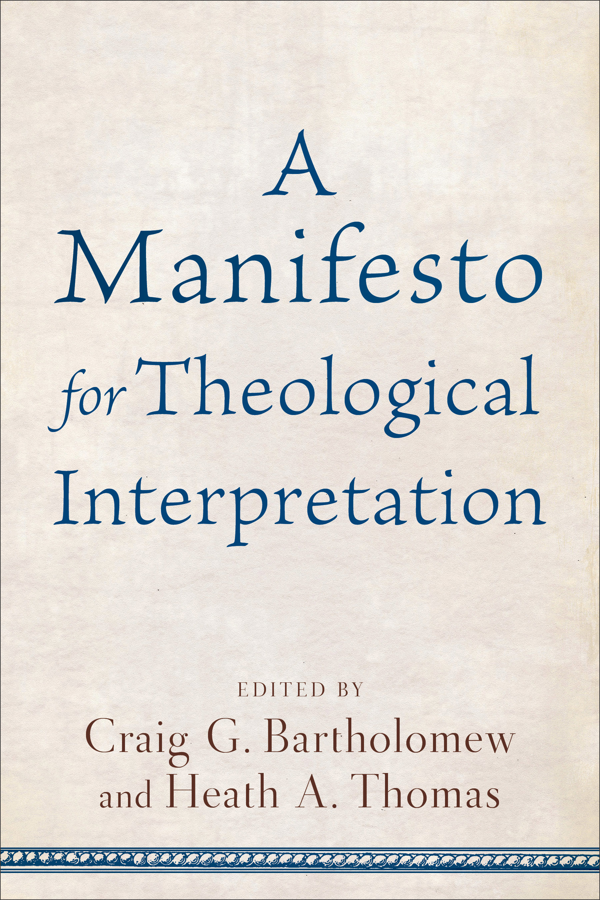
A couple of weeks ago I finished reading, A Manifesto for Theological Interpretation, edited by Bartholomew and Thomas. It’s important for our preaching because of the way in which they define TI (or TIS, theological interpretation of scripture):

“…we define broadly as interpretation of the Bible for the church…” (p. ix.)

The question is, what do they mean “for the church”?

I usually expand the definition a little bit by saying that TI/TIS is interpreting Scripture so it functions for the church.

But, then, what do I mean by “function”?

Think of the function of Scripture in terms of what God intends for Scripture to do to His readers. You might recognize that this meaning of TI closely resembles what we’ve always known as the application of Scripture. Christopher Wright wrote describes this as applying life to the Bible (I think he wrote this in his book, The Mission of God).

On page 17 they define TI as:

“…theological interpretation reads Scripture to hear God’s address, so that the church might be transformed into the image of Christ of the sake of the world.”

With those definitions in mind, our pressing question is, how does the text signal its intention?

I’ve been preaching through Matthew’s gospel since returning from my sabbatical so here’s an example from this morning’s study time. My preaching portion is Matthew 15:1-9. The religious leaders question Jesus about His disciples breaking “the tradition of the elders” (they don’t wash their hands!). Jesus replies by challenging them about their habit of breaking God’s commandments by the way they keep their traditions (they don’t care for their parents because they give the money to God).

In vv. 7-9 Jesus insults them (calling them “hypocrites”) and announces to them that Isaiah prophesied about them.

So, it’s fairly clear to me after my Monday morning study session that this text is designed to make sure all professing Christians do not follow the example of the religious leaders. They function as a “go and do otherwise” example.

If you have your text for this coming Sunday, can you identify early on how it functions for the church?

May our Lord receive glory in the church and in Christ Jesus (Ephesians 3:21) as we practice theological interpretation each week.

Randal

Our Final, Hope-filled Instructions: Preaching Through All Of Numbers

What a sense of accomplishment!
Photo by Etienne Girardet on Unsplash

This post completes the series I enjoyed through the book of Numbers with our faith-family.

My preaching portion was 33:50–36:13. I know it’s a lot of text, but we were at the end of the series and these instructions were far from new to our congregants.

The structure is clear with the repeated or restated version of: “And the Lord spoke to Moses…” (cf. 33:50; 34:1, etc.). These instructions for God’s people to live successfully in the Land must somehow translated into instructions that help us in our faith-journey with the Lord.

Then, as always, we follow the narrative to identify the theology:

  1. Our ongoing fight against cultural idols is in vv. 33:50-56. The theology shines through the command to get rid of the temptations and the warning of what will happen if God’s people don’t. Our walk with God requires constantly putting sin to death in the power of His Spirit.
  2. Our secure piece of the Promised Land in vv. 34:1-29; 36:1-13. Every person receives their inheritance (cf. 36:8). The special case revolving around a command to give a piece of the Land to a man’s daughters makes it clear that everyone was entitled to enjoy the blessing of God. The same goes for genuine believers enjoying their spiritual inheritance (cf. Acts 20:32 “…and to give you the inheritance among all those who are sanctified.”). As a good theologian, you will have to help them see why this inheritance means the world to God’s people.
  3. Our commitment to worship in vv. 35:1-8. This section centers on the implications of providing a place for the Levites in the Land. God’s people are surrounded by priests who will help them maintain a vital connection to their God.
  4. Finally, our commitment to value human life in vv. 35:9-34. Some of the strangest sections in the OT for me are those instructions concerning creating cities of refuge. Yet, because the presence of God made the Land and the people holy, it was crucial for human life to be taken seriously and the taking of human life to be taken seriously. In his commentary, Wenham speaks of “the most potent pollution of shed blood.” The same life-giving element that covered sins could also become destructive.

Anyway, I settled on these four hope-filled instructions from the final sections of Numbers. The book closes with:

“These are the commandments and the rules that the Lord commanded through Moses to the people of Israel in the plains of Moab by the Jordan at Jericho” (36:13).

And I know our Lord receives glory in the church and in Christ Jesus (Ephesians 3:21) when the instructions are preached.

Randal

P.S. Next time I will try to share what I learn each time I complete a lengthy sermon series through books of the Bible, especially the OT.

P.P.S. For those who may be looking for a Christological reading of Numbers, look no further than 1 Corinthians 10:1-14.

Looking Back On Our Faith-Journey: Preaching Through Numbers

Preaching God’s Review of Israel’s Journey

One of the joys of attempting to preach through a book of the Bible like Numbers is the satisfaction of having done it. I know it doesn’t sound very spiritual, but there is some truth to it. “Done it” includes tackling tough chapters like 33 where Israel’s journey is reviewed.

I structured the sermon with two points (gasp!):

  1. Looking back at God’s powerful redemption (vv. 3-4)
  2. Our struggle to trust Him (vv. 8, 9, 14-16, 40)

I selected just a few of the 56 verses in the review. By this time in the series there is much repetition. Evidently God wanted us to see how far He has brought us, how much we’ve put Him through, and yet He’s still faithful.

Consider doing some work on Passover (v. 3), such an important concept for our redemption.

Encourage your folks with: “the people of Israel went out triumphantly in the sight of all the Egyptians, while the Egyptians were burying all their firstborn….On their gods also the Lord executed judgments” (vv. 3-4). Let that look in the rearview mirror bolster your faith and theirs in the fight for faith and faithfulness! Some in our faith-families could sure use a dose of victory over the enemy.

In the second part of the sermon I selected tests of faith to remind us all of the struggle we’re in every day:

  • v. 8 and crossing the sea into the wilderness caused quite the test of faith!
  • vv. 9, 14 and the issue of water: almost dying of thirst and then the 12 springs of water!
  • v. 16 and that disastrous request for meat to eat that ended up with the name: “graves of craving” as the Lord judged His people with a great plague!
  • v. 40 and the enemy, Canaanites, that constantly threatened Israel’s enjoyment in the land!

After all that, there they were ready to enter and enjoy the Promised Land. And here we are enjoying the presence of God.

There’s only one way to explain a people like us enjoying God like this. It’s all because He is faithful to His promises.

And if you were interested in a Christological reading of Numbers 33 look no further than the reference to Passover (v. 3), our Passover Lamb, the buried Firstborn of our God (v. 4).

I hope these posts through books of the Bible, especially those in the OT, will encourage you to take your people there. May our Lord receive glory in the church and in Christ Jesus as you do (Ephesians 3:21).

Randal

Looking Out For #2: Preaching Through Numbers

We Really Are In This Faith-Race Together
So We Can’t Only Look Out For #1!

Back to preaching through Numbers this week.

When you arrive at Numbers 32 you’ll encounter a tricky narrative (at least I found it especially challenging).

Best to allow the storyline to carry the theology along. [I hope you are seeing through this series that you can trust the storyline.]

In this case God teaches us through a combination of storyline and the concepts of inheritance and unity. The storyline is the starting point for theological interpretation of narrative. The concepts of inheritance begins with reference to “the land of Jazer and the land of Gilead…” (v. 1) and is specified in vv. 18-19, “our inheritance has come to us on this side of the Jordan…”

I divided the narrative like this:

  1. an example of self-interest for good reason (vv. 1-5)
  2. which created unintended spiritual dangers (vv. 6-15)
  3. but led to cooperation in the fight for faith (vv. 16-42)

Long before the Book of Acts God provides the church with a look at how the Body of Christ operates.

Our congregants need to be reminded what’s at stake if our harmony is destroyed. Verse 15 summarizes what happened to the earlier generation: “For if you turn away from following him, he will again abandon them in the wilderness, and you will destroy all this people.” Pretty severe.

Ancient interpreters censure the actions of the two tribes, but as you can see in vv. 16ff. they adjust to Moses’s plea, stick to their idea of settling this side of the Jordan, but, most importantly, agreeing to “take up arms, ready to go before the people of Israel, until we have brought them to their place” (v. 17).

Everything is aimed at every one of God’s people enjoying their inheritance. The chapter ends with resounding victory.

Great story of how God’s people are in the fight for faith together. That’s why we talk about “faith-family.”

And, if you were wondering how a Christ-centered reading might sound in this narrative, I selected moving from the humility of the two tribes to Paul’s description of our Savior in Philippians 2:1-8. Anyone who receives Christ’s sacrifice shares His mindset and lives with others in view.

I hope you can see how God can receive glory in the church and in Christ Jesus (Ephesians 3:21) through a journey through the Book of Numbers.

Randal

Just Trust the Narrative: Preaching Through Numbers

Do you trust the book of Numbers to speak to God’s people?

After writing last week’s post, I thought it might be good to show how I arrived at the theology. So, here goes:

First, trust the storyline of the narrative. Every part of the chapter hinges on God’s final assignment to Moses: “Avenge the people of Israel…” That’s why I titled the sermon: “He will bring us into this land” (remember, that was my unifying idea of the series): And that includes one day avenging His people.

Vengeance on the Midianites points forward to God’s future vengeance on all His enemies.

Everybody knows vengeance is His, not ours. All the worshipers need to come to grips with “the Lord’s vengeance” (v. 3). That’s especially important in a day when the air we breathe is polluted with the thought that the vengeance of God on His enemies is offensive to our post-modern sensibilities.

The only reason given in the chapter for this acts of judgment is in v. 16 “…these, on Balaam’s advice, caused the people of Israel to act treacherously against the Lord in the incident of Peor.” This review of what happened is the only explanation for the violent judgment. Follow the progression:

Step one: God’s people are tempted and fail the test.

Step two: God judges the tempters and His people are involved in the judgment.

You might take a look at the end of the Story when the Lord returns in such places as Revelation 19:11ff. “…in righteousness he judges and makes war….And the armies of heaven, arrayed in fine lines, white and pure, were following him…”

Finally, the bulk of the chapter and description highlights God’s people relishing in the victory, counting the plunder, and bringing the Lord’s offering. The chapter closes with: “And Moses and Eleazar the priest received the gold from the commanders of thousands and of hundreds, and brought it into the tent of meeting, as a memorial for the people of Israel before the Lord” (v. 54).

The difficulty is moving from the OT battle against the Midianites to providing comfort and encouragement to God’s people as they await His return.

While we wait, our own fight for loving God supremely rages on. May our Lord receive glory in the church and in Christ Jesus (Ephesians 3:21) as we place our hope in His soon return.

Randal