

Our New Commentary on Genesis Has Arrived!

John and I took seven years to write this! Slow, I know!! (*smile*)

What was “forthcoming” for some time is now here!

While I was away on my annual motorcycle ride to old Quebec City with seven others, Michele sent me a picture of the two boxes Kregel sent me. When I got home I had the joy of opening the author copies of my new commentary on Genesis.

It took approximately seven years to complete this project. More than once I said to the Lord, “I love Genesis, but I am so done with it!” (I’m writing now so God was gracious in understanding what I meant.)

The Kerux Commentary series matches a biblical scholar (Dr. John Soden) with a preaching specialist (me). As you’ll see, John did the lion’s share of the work. He is an excellent exegete and adept at starting the move from exegetical ideas to theological ideas that get closer to serving the church.

Each pericope begins with one page that includes an exegetical idea, theological focus, preaching idea, and preaching pointers. Then the section proper begins with Literary Structure and Themes, technical Exposition that includes translation analysis and outline points, extensive Theological Focus, and Preaching and Teaching Strategies.

In the Preaching and Teaching Strategies is a section on Exegetical and Theological Synthesis, an attempt to tie together the exegesis and theology to form a solid foundation for preaching insights. The Preaching Idea is repeated and followed by Contemporary Connections: What does it mean? Is it true? and Now What? (you might remember these as Haddon Robinson’s three functional questions; he used to say you can only do three things to an idea: explain it, prove it, or apply it; this section of the commentary does all three to the degree the preaching portion calls for them).

Finally, I provide suggested preaching outline(s), Creativity in Presentation, and Discussion Questions for preachers and teachers to consider.

Anyway, there it is in a nutshell.

What a privilege for me to be invited to participate. I thank our Lord for insights and endurance to accomplish this in the middle of an extremely busy time in my life. May our Lord receive glory in the church and in Christ Jesus (Ephesians 3:21) whenever Genesis is preached/taught.

Randal

Is Your Preaching More Translation Than Interpretation?

Your Preaching Reflects Your Understanding of Meaning

I am getting back into a more normal schedule after teaching two classes. The first was an eight week master’s level course at Lancaster Bible College, Hebrew Exegesis to Exposition. The second was a Doctor of Ministry cohort, From the Study to the Pulpit, at Gordon-Conwell Theological Seminary.

Here’s a look at the D.Min. group under the lights:

One of my goals was to help my new friends answer this basic question:

What does this pericope mean?

It sounds elementary, but proves quite challenging whether I’m posing the question to Masters, DMins, or PhD students.

If I asked you, “What does this Scripture mean?” how would you answer?

Exodus 4:24 At a lodging place on the way the Lord met him and sought to put him to death. 25 Then Zipporah took a flint and cut off her son’s foreskin and touched Moses’ feet with it and said, “Surely you are a bridegroom of blood to me!” 26 So he let him alone. It was then that she said, “A bridegroom of blood,” because of the circumcision.

What I’ve discovered is that we are better at providing meaning in the form of summary or translation. We’re heavy on word studies and translating all the interesting concepts in this brief, bizarre OT narrative. We use the best tools we can to get to the bottom of their respective meanings.

If we are trained in some variation of identifying the big idea, we might present meaning as one cumbersome sentence that captures the interrelationship between the ideas of the narrative:

The results of the Lord meeting Moses and seeking to put him to death was that Zipporah circumcises their son, insults her husband, and the Lord let Moses alone.

Notice that this is not interpretation, but a summary of the narrative.

As I continue to teach the intersection of hermeneutics and homiletics, I keep urging my friends to consider what it means to interpret the meaning of a text.

More on that later.

For now, analyze your own method. Can you identify the meaning of the narrative? Does your meaning statement(s) include interpretation? If so, what is interpretation and what does that mean for your preaching/teaching?

Randal

Trying to Simplify Christ-Centered Preaching: A Summary of my Teaching at Dallas Theological Seminary

Michele and I Enjoying the Place Where it All Began!

First, thanks to the kindness of Calvary Bible Church’s leadership, I am on sabbatical this summer. That explains the inconsistent postings.

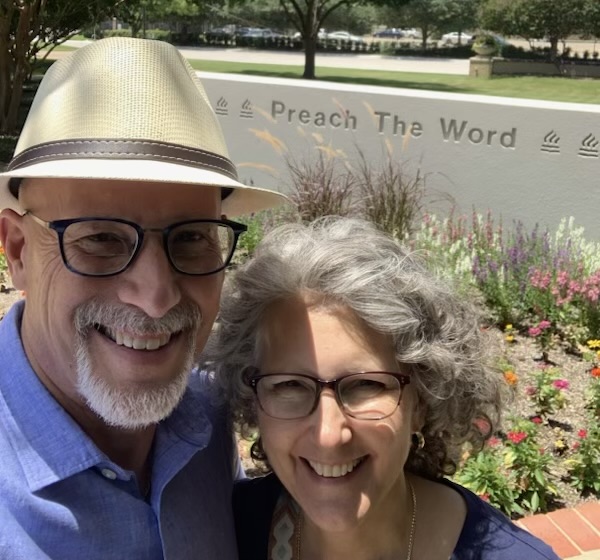
Second, the picture shows me and Michele in front of the sign off of Live Oak street on the campus of Dallas Theological Seminary. We stood by that sign in 1989 upon graduating with my Th.M. degree. What a special place for us!

Third, this past Tuesday I had the privilege to teach a Doctor of Ministry preaching cohort at DTS. This past fall the lead professor, Dr. Roger Raymer, asked if I would teach on redemptive-historical preaching.

To prepare, I read The Southern Baptist Journal of Theology (volume 22, number 3, fall 2018, titled, Preaching Christ from the Old Testament). My old DTS professor, Elliot Johnson, and WTS professor, Vern Poythress, were two major contributing authors. Along with another major contributor, Daniel Block, ten respected scholars evaluated each position. It’s a great way to familiarize yourself with some views.

My second task was deciding how to simplify some things since there is a dizzying array of thoughts about Christ-centered preaching. So, here is how I approached the subject matter:

  1. Think of the OT as containing two kinds of texts, salvation and judgment. A Christ-centered hermeneutic/homiletic will accomplish something like: (a) any salvation text in the OT functions for the church because those who are in Christ experience some facet of salvation mentioned in that OT text due to the Christ-event; (b) those in Christ escape the judgment announced in the text because God judged Christ on the cross. A primary hermeneutical question is how those texts will apply to the Church if you decide not to interpret/apply those texts within the context of the whole Canon of Scripture.
  2. Think of OT characters functioning in two ways, either “go and do likewise” or “go and do otherwise.” Just don’t ask parishioners to follow or avoid their example without first addressing the point above. That will keep you from sounding like you’re promoting moralism. Unlike the common alternative to Christ-centered preaching, God-centered, this approach allows the OT to guide our Christian lives just like the Apostles said it should (“These things were written as our examples…”).

Just a couple of ways to simplify some of the subject matter. Lots more could be said and I would be happy to discuss it further with you while I have extra time this summer!

May our Lord receive glory in the church and in Christ Jesus (Ephesians 3:21) as you preach Him each Sunday according to your method.

Randal

Our Final, Hope-filled Instructions: Preaching Through All Of Numbers

What a sense of accomplishment!
Photo by Etienne Girardet on Unsplash

This post completes the series I enjoyed through the book of Numbers with our faith-family.

My preaching portion was 33:50–36:13. I know it’s a lot of text, but we were at the end of the series and these instructions were far from new to our congregants.

The structure is clear with the repeated or restated version of: “And the Lord spoke to Moses…” (cf. 33:50; 34:1, etc.). These instructions for God’s people to live successfully in the Land must somehow translated into instructions that help us in our faith-journey with the Lord.

Then, as always, we follow the narrative to identify the theology:

  1. Our ongoing fight against cultural idols is in vv. 33:50-56. The theology shines through the command to get rid of the temptations and the warning of what will happen if God’s people don’t. Our walk with God requires constantly putting sin to death in the power of His Spirit.
  2. Our secure piece of the Promised Land in vv. 34:1-29; 36:1-13. Every person receives their inheritance (cf. 36:8). The special case revolving around a command to give a piece of the Land to a man’s daughters makes it clear that everyone was entitled to enjoy the blessing of God. The same goes for genuine believers enjoying their spiritual inheritance (cf. Acts 20:32 “…and to give you the inheritance among all those who are sanctified.”). As a good theologian, you will have to help them see why this inheritance means the world to God’s people.
  3. Our commitment to worship in vv. 35:1-8. This section centers on the implications of providing a place for the Levites in the Land. God’s people are surrounded by priests who will help them maintain a vital connection to their God.
  4. Finally, our commitment to value human life in vv. 35:9-34. Some of the strangest sections in the OT for me are those instructions concerning creating cities of refuge. Yet, because the presence of God made the Land and the people holy, it was crucial for human life to be taken seriously and the taking of human life to be taken seriously. In his commentary, Wenham speaks of “the most potent pollution of shed blood.” The same life-giving element that covered sins could also become destructive.

Anyway, I settled on these four hope-filled instructions from the final sections of Numbers. The book closes with:

“These are the commandments and the rules that the Lord commanded through Moses to the people of Israel in the plains of Moab by the Jordan at Jericho” (36:13).

And I know our Lord receives glory in the church and in Christ Jesus (Ephesians 3:21) when the instructions are preached.

Randal

P.S. Next time I will try to share what I learn each time I complete a lengthy sermon series through books of the Bible, especially the OT.

P.P.S. For those who may be looking for a Christological reading of Numbers, look no further than 1 Corinthians 10:1-14.

Looking Back On Our Faith-Journey: Preaching Through Numbers

Preaching God’s Review of Israel’s Journey

One of the joys of attempting to preach through a book of the Bible like Numbers is the satisfaction of having done it. I know it doesn’t sound very spiritual, but there is some truth to it. “Done it” includes tackling tough chapters like 33 where Israel’s journey is reviewed.

I structured the sermon with two points (gasp!):

  1. Looking back at God’s powerful redemption (vv. 3-4)
  2. Our struggle to trust Him (vv. 8, 9, 14-16, 40)

I selected just a few of the 56 verses in the review. By this time in the series there is much repetition. Evidently God wanted us to see how far He has brought us, how much we’ve put Him through, and yet He’s still faithful.

Consider doing some work on Passover (v. 3), such an important concept for our redemption.

Encourage your folks with: “the people of Israel went out triumphantly in the sight of all the Egyptians, while the Egyptians were burying all their firstborn….On their gods also the Lord executed judgments” (vv. 3-4). Let that look in the rearview mirror bolster your faith and theirs in the fight for faith and faithfulness! Some in our faith-families could sure use a dose of victory over the enemy.

In the second part of the sermon I selected tests of faith to remind us all of the struggle we’re in every day:

  • v. 8 and crossing the sea into the wilderness caused quite the test of faith!
  • vv. 9, 14 and the issue of water: almost dying of thirst and then the 12 springs of water!
  • v. 16 and that disastrous request for meat to eat that ended up with the name: “graves of craving” as the Lord judged His people with a great plague!
  • v. 40 and the enemy, Canaanites, that constantly threatened Israel’s enjoyment in the land!

After all that, there they were ready to enter and enjoy the Promised Land. And here we are enjoying the presence of God.

There’s only one way to explain a people like us enjoying God like this. It’s all because He is faithful to His promises.

And if you were interested in a Christological reading of Numbers 33 look no further than the reference to Passover (v. 3), our Passover Lamb, the buried Firstborn of our God (v. 4).

I hope these posts through books of the Bible, especially those in the OT, will encourage you to take your people there. May our Lord receive glory in the church and in Christ Jesus as you do (Ephesians 3:21).

Randal

Just Trust the Narrative: Preaching Through Numbers

Do you trust the book of Numbers to speak to God’s people?

After writing last week’s post, I thought it might be good to show how I arrived at the theology. So, here goes:

First, trust the storyline of the narrative. Every part of the chapter hinges on God’s final assignment to Moses: “Avenge the people of Israel…” That’s why I titled the sermon: “He will bring us into this land” (remember, that was my unifying idea of the series): And that includes one day avenging His people.

Vengeance on the Midianites points forward to God’s future vengeance on all His enemies.

Everybody knows vengeance is His, not ours. All the worshipers need to come to grips with “the Lord’s vengeance” (v. 3). That’s especially important in a day when the air we breathe is polluted with the thought that the vengeance of God on His enemies is offensive to our post-modern sensibilities.

The only reason given in the chapter for this acts of judgment is in v. 16 “…these, on Balaam’s advice, caused the people of Israel to act treacherously against the Lord in the incident of Peor.” This review of what happened is the only explanation for the violent judgment. Follow the progression:

Step one: God’s people are tempted and fail the test.

Step two: God judges the tempters and His people are involved in the judgment.

You might take a look at the end of the Story when the Lord returns in such places as Revelation 19:11ff. “…in righteousness he judges and makes war….And the armies of heaven, arrayed in fine lines, white and pure, were following him…”

Finally, the bulk of the chapter and description highlights God’s people relishing in the victory, counting the plunder, and bringing the Lord’s offering. The chapter closes with: “And Moses and Eleazar the priest received the gold from the commanders of thousands and of hundreds, and brought it into the tent of meeting, as a memorial for the people of Israel before the Lord” (v. 54).

The difficulty is moving from the OT battle against the Midianites to providing comfort and encouragement to God’s people as they await His return.

While we wait, our own fight for loving God supremely rages on. May our Lord receive glory in the church and in Christ Jesus (Ephesians 3:21) as we place our hope in His soon return.

Randal

Preaching “the Lord’s vengeance”: Preaching Through Numbers

God says, “Trust Me. Leave the vengeance to Me!”

When you decide to preach through Numbers, your listeners will learn a great deal of theology.

For instance, when you arrive at Numbers 31:1-54 you encounter a huge narrative that I titled:

“He will bring us into this land”: And That Includes One Day Avenging His People

God’s final assignment for Moses is in v. 2 “Avenge the people of Israel on the Midianites. Afterward you shall be gathered to your people.”) In v. 3 Moses says to the people that they are “to execute the Lord’s vengeance on Midian (emphasis added).”

Verses 1-6 help us come to grips with “the Lord’s vengeance.” As I’ve reminded our faith-family several times over the years, non-Christians will not tolerate a God of judgment. These narratives, like many in the Old Testament, force God’s people to consider the ramifications of God’s holiness–His judgment on all who oppose Him.

Verses 13-20 describe what’s at stake and provides a reason for such commands of God. Verse 16 says, “Behold, these, on Balaam’s advice caused the people of Israel to act treacherously against the Lord in the incident of Poor, and so the plague came among the congregation of the Lord.”

If there is any way we can understand these actions, we must at least attempt to explain how devastating it is to the Lord for His people to act treacherously against Him. All of this is the stuff of robust theologian/pastors.

Finally, verses 7-12 and 21-54 provide an opportunity to place ourselves in the camp of God’s people and relish in our resounding victory. Over and over again God defeats His enemies, including the final battle.

If someone were to ask about the relevance of all this I might talk about things like:

  1. Even though God’s people don’t carry out this instruction to Moses, God will one day, once again, judge all those who oppose Him.
  2. That should encourage us since God’s people have always faced the same thing our Lord faced when He was on earth. The world hated Him, remember (think John 17 stuff).
  3. This kind of God–our God–should scare us to death. We’ve seen throughout Numbers how God judged His own people. It’s no wonder a NT writer talked about judgment beginning in God’s house. I continue to define the fear of the Lord in the OT as our glad submission to the God who is not safe.

May you continue to mine the theological depths of Numbers and He will continue to receive glory in the church and in Christ Jesus (Ephesians 3:21).

Randal

Preaching the Bazillion Offerings in Numbers: Preaching Through Numbers

What’s a preacher to do with all those offerings in Numbers 28:1–29:40?!?

If there is a section in Numbers that might discourage you from preaching/teaching through the entire book, it’s 28:1–29:40 with its bazillion offerings.

My attempt to interpret it so it functions for the church was:

Title: “He will bring us into this land”: And We Will Gladly Give Him Our Entire Life

First, the narrative is a “go and do likewise” narrative. In some way, shape, or form, we are to follow through with what the Lord commands His people to do.

Second, how might you go about identifying theology in this exhaustive and exhausting list of offerings? I decided to present what God is saying to us in these two chapters. Each quote hopefully faithfully represents the accompanying verses:

  1. “It belongs to Me!” (says the Lord, in the repetition of “my” in v. 2)
  2. “I like it very much!” (28:2, 6, 8, 13, 24, 27; 29:2, 6, 8, 13, 36 and all the references to “pleasing aroma”)
  3. “But it has to be just right!” (28:2b, 3, 9, 11, 19, 31; 29:2, 8, 13, 17, 18, 20, 21, 23, 24, 26, 27, 29, 30, 32, 33 covering all the regulations of when, what kind, and how much)
  4. “And don’t forget to stop working!” (28:18, 25, 26; 29:1, 7, 12, 35 all dealing with the Sabbath rest: “You shall not do any ordinary work”)

I am a huge fan of grouping ideas for pedagogical reasons, in contrast to moving verse by verse, especially in a section like this.

Throughout this sermon we’re not talking about OT offerings, but what the Lord requires of us and how that fits into our relationship with Him.

Some will want to sprinkle in allusions to NT offerings such as the sacrifice of praise, or giving thanks, or offering our whole selves.

And some will want to make sure that all this talk about sacrifices to God takes place in the context of His ultimate Sacrifice of His Son. Everything we offer Him is in response to His best Gift.

I hope you will make an attempt to preach or teach this some day, if you haven’t already. And I know our Lord will receive glory in the church and in Christ Jesus (Ephesians 3:21).

Randal

Teaching for a New Generation: Preaching Through Numbers

“I will learn from the past generation.”

When you arrive at Numbers 26 in your series, you encounter 65 verses devoted to listing all the new generation of Israelites. Very exciting, I know.

Verse 64 says, “But among these there was not one of those listed by Moses and Aaron in the wilderness of Sinai.”

You can help your listeners make sense of the second set of numbers in Numbers–the first census was in chapter 1–by pointing out both warning and blessing.

The warnings are in vv. 9-10 (“…and they became a warning”), v. 61 (“But Nadab and Abihu died when…”) and v. 65 (“They shall die in the wilderness”). Hebrews 3:12–4:13 teaches us to hear their story; heed the warning.

The blessing of God is seen in the number of people. Compare the numbers in v. 1:46 and 26:51 to see that God has raised up almost an identical number of Israelites. God has not forgotten His promises He made to Abraham in Genesis 12:2!

So, early in the book we encouraged our listeners to align with Caleb and Joshua; now we urge them to see their walk with God pictured in this new generation’s fight for faith. Will they?/will we learn from the previous generation’s failures, fight for faith, and worship the Lord?

The daughters of Zelophehad provide an example for us to follow in 27:1-11 as they boldly ask for an inheritance. Those of you who are reading Hebrew regularly will note that v. 5 contains larger, bold letters to signify that women were bringing the request! Their request creates new legislation that makes sure everyone has an opportunity for an inheritance in the land. Every listener needs to have that same faith that fellowship with God in His kingdom is that important. Everyone needs to be encouraged to enjoy their spiritual inheritance (cf. Ephesians 1).

So far we are in the same fight for faith, with the same opportunities for enjoying our spiritual inheritance, and…

27:12-23 revealed the same opportunity to be shepherded along the journey. Our Lord was concerned “that the congregation…may not be as sheep that have no shepherd” (v. 17). God gives them Joshua and, to cut this sermon short, He continues to give His people our Great Shepherd and all those gifted under-shepherds to guide the faith of His people.

And He will receive glory in the church and in Christ Jesus (Ephesians 3:21) as you help your listeners/learners learn from the unbelief of that infamous first generation who died in the wilderness.

Randal